
Saving Water
Wai (water) is one of our most important natural resources, but we usually take it for granted because for most of us, access to clean and fresh water is as easy as turning on the tap. The good news is that it’s incredibly easy to change habits and take a few simple actions around your home to reduce water usage.
Thanks to our free advice, the people we’ve worked with have saved on average $409 each on their annual water bills.
What is a Water Check?
If your water use is higher than average and you do not have a leak, you are eligible for a Water Check, where one of our Sustainability Advisors visits your home to look at all things water-related. This free check takes about an hour, and any water-saving devices we install are also free of charge. We’ll check everything from your flow rate to your water meter to make sure you aren’t losing or using water needlessly.
Our Water Check includes:
- Water saving advice for each area of your home
- Flow rate tests for showers and mixer taps
- Free water saving products and installations (where relevant)
- Instructions on how to do a leak test
- Identifying your water meter
- Personalised water saving recommendations
Please note that our service does not include finding or fixing leaks. If you think your water use might be high due to a leak, we highly recommend doing a leak test, and you can read more here about what to do in case of a leak.
Why should I sign up for a Water Check?
Have a look at your water bill to get a better understanding of how your household compares to others when it comes to water usage. The graph below shows the average amount households pay each month for water in Auckland.
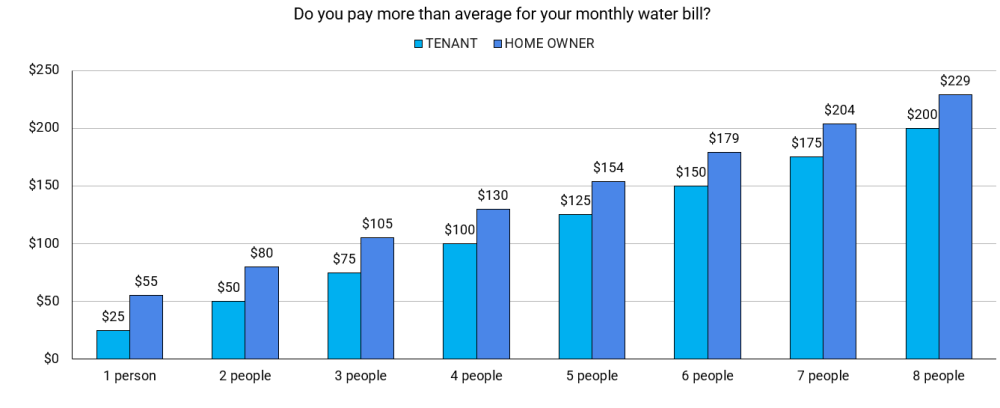
If your water bill is above average, you could benefit from a free Water Check. We can help you find out why your water bill is high and how you could reduce your water use. Please note that our service does not include finding or fixing leaks, so you will need to perform a leak test before being eligible for a Water Check.
Do your own Water Check in your own time
If a home water check on a weekday doesn’t suit you, you can do our DIY Interactive Water Check, an online version of our full service, which you can do in your own time and at your own pace. If you are a Watercare customer you will still receive a follow up with personalised water saving recommendations.
Health & safety during home visits
- Wearing masks (and asking you to do the same)
- Keeping 2m distance where possible, sanitising all surfaces, and putting on gloves before touching anything
- We’re also asking you to keep all windows and doors open during the visit
We strive to keep everyone safe during all home visits. The day before we visit your home, we’ll contact you to confirm your booking and to go through some safety questions. If you or anyone in your household or close circle is or has been ill, please let us know. We are always happy to reschedule visits to a later date that suits. As we visit you in your home, it’s essential we are aware of any potential risks to the health and safety of our team.
If you are not comfortable with a team member coming into your home, that is absolutely fine. Let us know and we will talk you through our other support options.
Waterwise Workshops
We are also offering in-person Waterwise workshops in red and orange settings. Again, keeping everyone safe will be our top priority, i.e. spaced seating, mask-wearing, and well-ventilated rooms – we can chat about this when you book, and we’ll organise to visit your venue before the event so we all know how the workshop will run.
Workshops can be held with a minimum of ten people, and up to 25 (with spaced seating). Workshops take about an hour and a half, which includes time for questions and answers.
For information about our Waterwise Workshops, email [email protected].
Reducing your flow rate
Every tap and shower in your house has a specific flow rate, which is the amount of water coming out of the fitting. We measure flow rates in litres per minute, with 9 litres per minute or less being ideal. Measuring the flow rate of your taps is easy and only takes a couple of minutes, check out our how-to video below.
If you discover your flow rate is higher than 9 litres per minute, you can install flow restrictors. These are widely available through plumbing and hardware stores. Reducing your flow rates will help with lowering both your water and power bills.
Take a look at how easy it is to install devices in our videos below.
Before buying a water flow restrictor, we recommend chatting to a plumber to ensure the restrictor is compatible with your hot water cylinder.
find out more
- Book a free water check
- How to test for leaks
- How to locate your leak
- Being waterwise booklet
- Safely install water saving devices
RAINWATER HARVESTING
- Online video – Introduction to Rainwater Harvesting with Laurie Dee
- Rainwater harvesting kit information
STORIES
“Thank you so much for taking the time to visit, installing water efficient devices and for your bespoke feedback following our water check.”
“I really appreciated your advice and encouragement around the efforts I’ve made to conserve water – it’s great to understand such small actions can make such a large and positive difference.”
“Thank you so much for your visit today. I learned a lot and am very goal-oriented now to get that water bill down. Goodbye half loads in the washing machine, and baths! A brilliant service.”
“Your recommendations were very helpful. The tips you gave us are easy to understand and implement, and I’m confident that we will be able to save a significant amount of water thanks to your advice.”
“Thank you for following up. The water bill has gone down now. Thanks for your tips in reducing water consumption… we had a leak in the hot water cylinder which has been fixed. Thank you so much for these brilliant ideas around saving water use at our place.”
How to measure your flow rate:
How to install a flow restrictor:
How to install a tap aerator:
Kia ora and thanks to
Watercare for providing water checks and water saving advice free of charge.